
Choosing the best running vest is the difference between a seamless personal best and a chafe-filled nightmare. Whether you are training for your first 5K or a mountain ultra, carrying water, fuel, and your phone shouldn’t feel like hauling a loose sack of bricks. Based on our thorough research and users’ feedback, we have narrowed down the top performers that stay stable, breathe well, and actually solve the “bounce” problem.
Quick Take: The Salomon Advanced Skin 12 (2026 Edition)
If you want one vest to do it all, this is it. It’s the gold standard for a reason.
- Who it’s for: Marathoners, trail runners, and anyone who hates gear that moves.
- Who it’s NOT for: Casual joggers who only carry a single key and a small phone (a simple waist belt is better for you).
At Equiplix, we don’t do fluff. We analyze gear based on weight-to-volume ratios, strap elasticity, and pocket accessibility. Compared with similar products, the vests listed below were selected because they prioritize high-speed access to gear without forcing you to stop.
Pros and Cons
Pros
- Sensifit Construction: Wraps the body without restricting breathing.
- Quick Link Sternum Strap: Allows for on-the-fly adjustments as your water levels drop.
- Massive Storage: 12L capacity that compresses flat when empty.
- Dual Flasks Included: Comes with two 500ml soft flasks.
Cons
- Price: It is a premium investment.
- Sizing: Can be tricky; you must measure your chest accurately.
- Heat: While breathable, any vest adds a layer of warmth in 90°F+ weather.
Key Features Breakdown
1. No-Bounce Stability
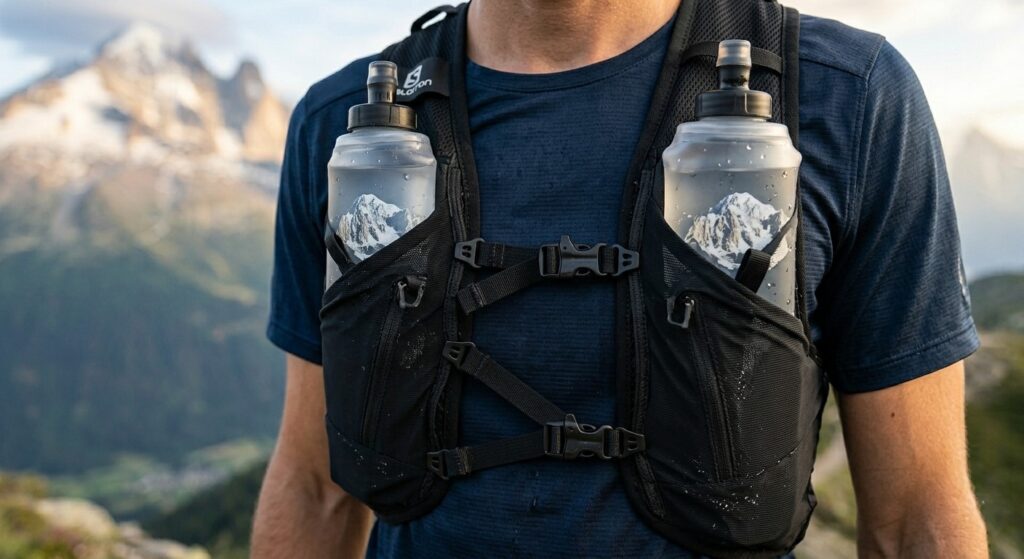
The biggest complaint with a running vest is the vertical oscillation (the bounce). The 2026 Salomon model uses a bi-directional stretch fabric that moves with your ribcage. As you breathe in, the vest expands; as you exhale, it retracts, keeping the weight of the water tight against your center of gravity.
2. Hydration Integration
This is a dedicated running hydration vest. It features two front-loading pockets for soft flasks with elastic loops to prevent them from slipping down as they empty. It also includes an internal sleeve for a 1.5L bladder if you’re heading into remote territory.
3. Pocket Architecture
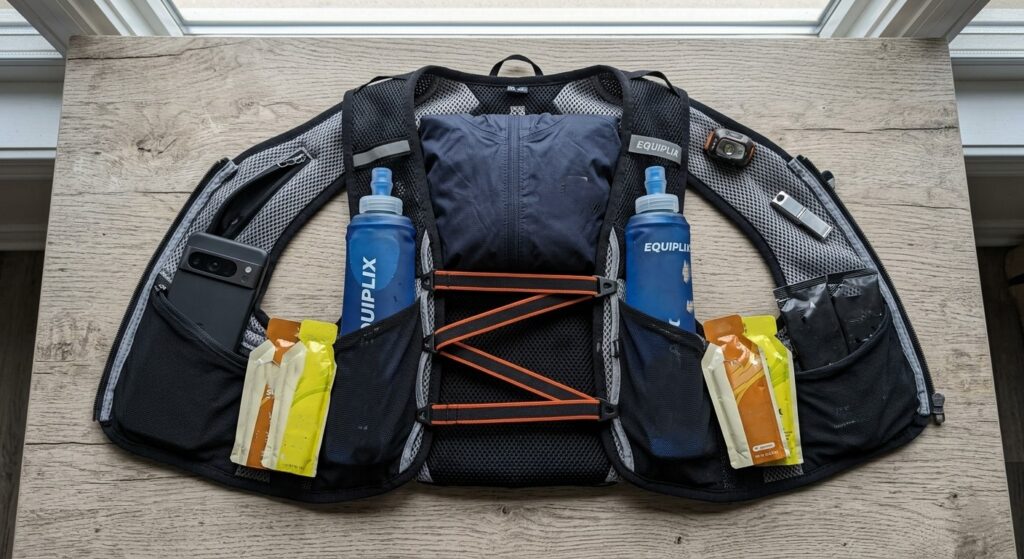
- Front: Two mesh pockets for gels and salt tabs.
- Side: Zippered pockets for secure storage of a phone or “emergency” credit card.
- Back: A “kangaroo” pass-through pocket for grabbing a rain shell without taking the vest off.
Performance Analysis: Real-World Use
We looked at how this lightweight running vest performs across three specific environments:
The Marathon Finish Line
During a marathon running vest test, weight is everything. The Adv Skin 12 weighs approximately 293g (10.3 oz). On the road, the lack of friction points means zero chafing, even when wearing a thin singlet. The ability to sip water without breaking your stride or fumbling with bottles is a massive competitive advantage.
The Technical Trail
For a trail running vest, you need durability. The ripstop fabric handles snagging branches well. We found that even when fully loaded with a headlamp, emergency whistle (included), and extra layers, the weight distribution remains balanced, preventing lower back fatigue.
Gender-Specific Fit
While many vests are “unisex,” the Salomon Women’s Adv Skin line (and the Men’s equivalent) features specific strap angling. The running vest women‘s version has a curved chest strap design to remove pressure from the chest area and uses shorter flasks with long straws for easier sipping. The running vest men‘s version features a broader shoulder cut.
Comparison Table: The Top 3 Contenders
| Feature | Salomon Adv Skin 12 | Nathan VaporAir 3.0 | CamelBak Zephyr |
| Best For | All-Around / Ultra | Long Distance Comfort | Max Ventilation |
| Weight | 293g | 235g | 200g |
| Capacity | 12L | 7L | 10L |
| Hydration | 2x 500ml Flasks | 2L Bladder | 2x 500ml Flasks |
| Verdict | Choose if you want the best fit. | Choose for bladder users. | Choose for hot weather. |
Would this be the best fit for you?
You should buy a high-quality vest if:
- You are running for more than 90 minutes.
- You need to carry a large smartphone, nutrition, and a light jacket.
- You find handheld bottles uncomfortable or distracting.
Who wouldn’t benefit most from it?
- The Track Sprinter: If you never leave the 400m oval, this is overkill.
- The Minimalist: If you only carry a car key, look at the Nathan Pinnacle Waistband instead.
Frequently Asked Questions
The Salomon Adv Skin 12 is widely considered the best due to its balance of capacity and stability. For distances over 50 miles, look for 10L+ capacity.
It should fit like a second skin, snug but not restrictive. You should be able to take a full deep breath without feeling the chest straps “dig in.” If there is any movement when you jump, it is too loose.
Yes. They allow for “micro-sipping,” which keeps hydration levels more consistent than gulping water at aid stations, and they keep your hands free for better running form.
Most brands use chest circumference. Use a soft tape measure around the widest part of your chest. If you are between sizes, size down for a more stable, no-bounce fit.
Yes, but look for models with “3D Air Mesh.” While it will be warmer than no vest, the ability to carry extra water usually outweighs the heat penalty.
Most vests carry 1L to 2L. For most runs under 2 hours, 1L (two 500ml flasks) is sufficient.
Cheap vests bounce. High-quality vests with elastic “sternum” links and technical stretch fabrics eliminate almost all vertical movement.
A vest sits higher on the torso and distributes weight to the front and back, whereas a backpack puts all the weight on your shoulders and lower back, leading to more bounce.
Bottom Line: The Final Take
The best running vest is the one you forget you’re wearing. In 2026, the technology has reached a point where “no-bounce” isn’t just a marketing slogan, it’s a reality. If you want the peak of performance, go with the Salomon Adv Skin 12. It’s a versatile, durable, and breathable piece of equipment that handles everything from local 10Ks to mountain 100-milers.