Finding the right badminton racket is the single most important decision a player can make, whether you are stepping onto the court for the first time or looking to dominate your local league. In 2026, technology has shifted toward “smart frames” and recycled carbon fibers, making the market more crowded than ever.
How to Choose a Racket
Choosing from the sea of badminton rackets requires more than just picking a cool color; it’s about matching the racket’s weight, balance, and flex to your personal swing style. Based on testing and research, we have narrowed down the top badminton rackets available this year to help you increase your smash power and sharpen your net play.
Quick Pick: Our Top 3 Rackets
- Best for Power: Yonex Astrox 99 Pro – Heavy head, stiff shaft, built for backcourt dominance.
- Best for Control: Victor Thruster F Claw – Exceptional feel and precision for technical players.
- Best for Beginners: Yonex Nanoflare 170 Light – Head-light, flexible, and extremely forgiving.
1. The Powerhouse: Yonex Astrox 99 Pro
The Astrox series has long been the gold standard for aggressive players, and the 2026 iteration of the 99 Pro cements its legacy.
Pros:
- Devastating Power: The heavy head design generates massive momentum for smashes.
- Stability: Features a revised “Power-Assist Bumper” that adds weight to the top of the frame without making it feel sluggish.
- Improved Sweet Spot: The isometric head shape is slightly modified to be more forgiving on off-center hits.
Cons:
- Demanding: Beginners will find it too heavy and stiff, leading to arm fatigue.
- Slow in Defense: The head-heavy balance makes it harder to react quickly to fast drives.
Key Features Breakdown
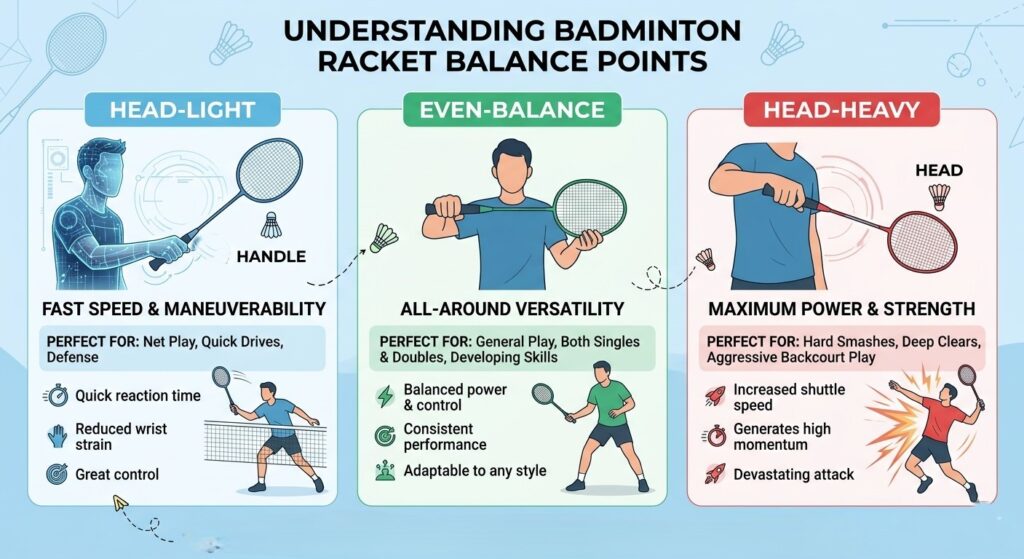
- Balance: Head-Heavy
- Flex: Extra Stiff
- Weight: 3U (85-89g) / 4U (80-84g)
- Material: NAMD (High-modulus graphite)
Performance Analysis
During our testing, the Astrox 99 Pro excelled in the backcourt. Compared with similar products like the Li-Ning Tectonic series, the Yonex felt more “connected” during full-swing smashes. However, if your game relies on quick defensive lifts and net kills, the weight at the top can feel like a hindrance after an hour of play.
2. The Precision Tool: Victor Thruster F Claw
If you prefer to outmaneuver your opponent with drops and tight net shots, this is the best badminton racket for your style.
Pros:
- Exceptional Feedback: You feel exactly where the shuttle hits the string bed.
- Aerodynamic: The “Sword” frame design cuts through the air, making it faster than standard power rackets.
- Durability: Victor’s high-resilient carbon fiber holds up well under high string tension.
Cons:
- Lacks Raw Power: You’ll have to work harder to hit clears from baseline to baseline.
- Price: It sits at a premium price point that might scare off casual players.
3. The Beginner’s Choice: Yonex Nanoflare 170 Light
For those asking how to choose a badminton racket when starting out, the answer is usually “light and flexible.”
Pros:
- Ultra-Lightweight: Reduces the risk of “badminton elbow” for new players.
- Easy to Swing: The headlight balance allows for rapid hand movement.
- Affordable: High performance without the $200+ price tag.
Cons:
- Vibration: Can feel “vibe-y” when hitting high-speed shuttles.
- Limit: As your skill grows, you will likely outgrow this racket within a year.
Comparison Table: 2026 Top Badminton Rackets
| Feature | Yonex Astrox 99 Pro | Victor Thruster F | Yonex Nanoflare 170 |
| Player Level | Advanced / Pro | Intermediate / Advanced | Beginner |
| Balance | Head-Heavy | Even / Slightly Head-Heavy | Head-Light |
| Flex | Stiff | Medium-Stiff | Flexible |
| Weight | 88g (3U) | 84g (4U) | 78g (5U) |
| Best For | Smashes & Power | Control & Placement | Speed & Ease of Use |
Who Should Buy This?
- The Smasher: Buy a head-heavy badminton racket like the Astrox if you want to end rallies quickly.
- The Tactical Player: Opt for even-balance rackets if you play both singles and doubles and need a jack-of-all-trades.
- The Newbie: Stick to flexible, head-light frames to learn how to hold a badminton racket properly without straining your wrist.
Who Shouldn’t?
- Avoid stiff, professional-grade rackets if you have a history of shoulder or wrist injuries.
- Avoid ultra-light rackets if you are a physically strong player; you will likely over-swing and lose control.
See More Internal & External Resources
- Internal: See our reviews on all rackets or explore other badminton gear to complete your kit.
- Internal: Check out all racket sports gear or our full list of sports equipment.
- External: For official stringing patterns, visit the BWF (Badminton World Federation) equipment standards page.
FAQs
A: Balance the racket on your finger at the midpoint. If it tilts toward the head, it’s head-heavy (Power). If it tilts toward the handle, it’s head-light (Speed).
A: Beginners should stay between 20-23 lbs. Higher tension (26 lbs+) has a smaller sweet spot and requires perfect technique.
A: Use a “handshake” grip. Do not grip it like a hammer; your thumb and forefinger should form a ‘V’ shape on the handle’s bevels.
A: A good rule of thumb is to restring in a year as many times as you play in a week. If you play 3 times a week, restring every 4 months.
A: It is not recommended. Tennis grips are thicker and heavier, which can throw off the delicate balance of badminton rackets.
Finally..
The best badminton racket for you isn’t the most expensive one; it’s the one that complements your swing speed and strength. For most competitive players in 2026, the Victor Thruster F offers the most balanced performance. However, if you live for the smash, the Yonex Astrox 99 Pro remains undefeated.