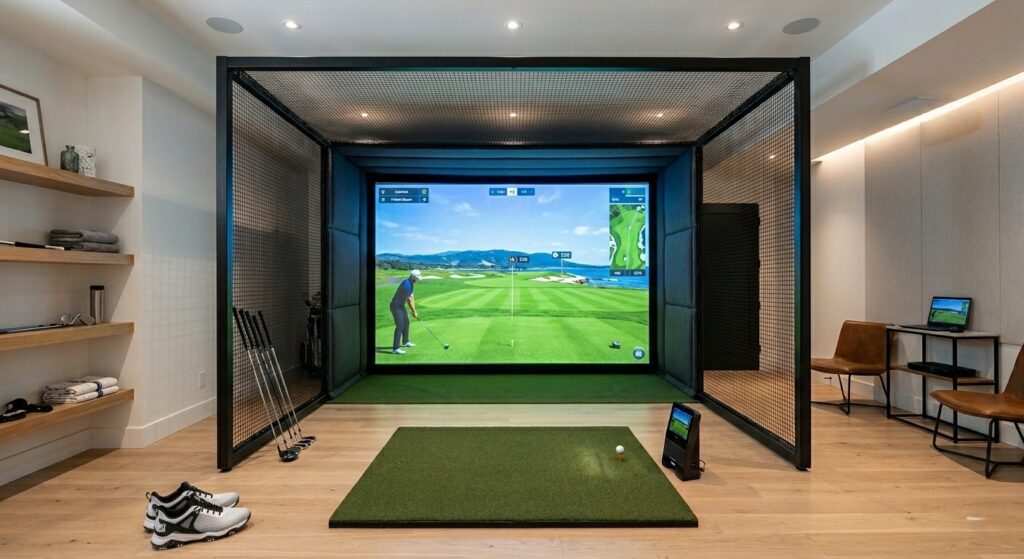
Dropping thousands on a home setup only to deal with missed shots, lagging software, and inaccurate yardages is a nightmare. Finding the best golf simulator for home requires cutting through the marketing hype to find a system that actually fits your budget, skill level, and ceiling height.
Whether you want a budget-friendly garage setup or a tour-level indoor studio, this guide eliminates the guesswork. We tested the top systems on the market to bring you the only recommendations you need to make a fast, confident buying decision.
Our Top Picks at a Glance
If you want to skip the deep dive and get right to practicing, these are the standout home golf simulators available right now.
- Best Overall Value: SkyTrak+ Launch Monitor. Hit real balls with dual-doppler radar and photometric precision without paying commercial prices.
- Best Under $1,000: Square Golf Launch Monitor. The undisputed budget king for dedicated indoor setups with zero subscription fees.
- Best Premium Performance: Foresight Sports GC3. Tour-level triscopic camera accuracy for serious players who demand perfect ball and club data.
Our Top Picks Reviewed
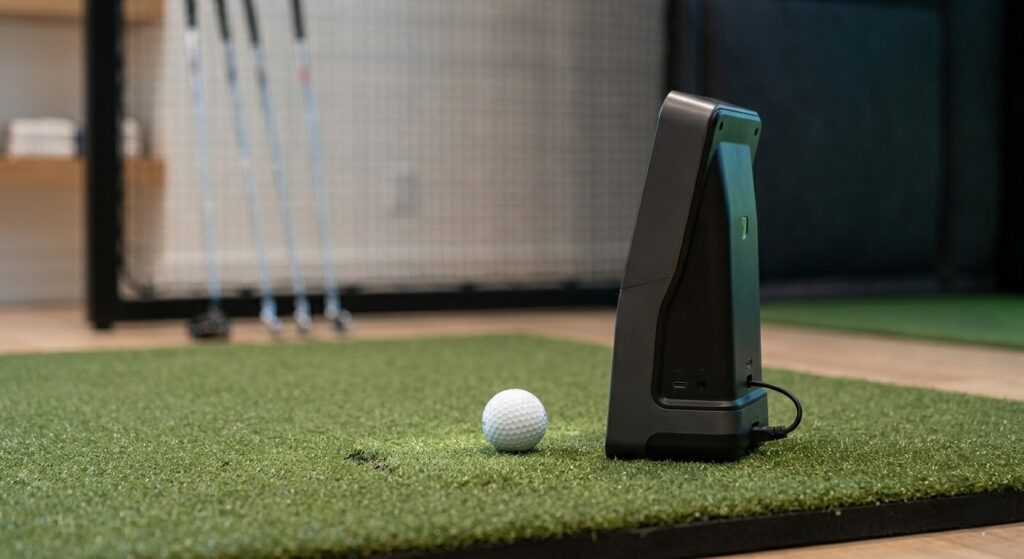
1. SkyTrak+ Golf Launch Monitor
The best home golf simulator for the vast majority of golfers looking to balance commercial accuracy with residential pricing. By pairing a dual-doppler radar system with high-speed photometric cameras, it reads club and ball data instantly without requiring special marked balls or stickers.
- Pros: Dual tracking system ensures zero missed shots; massive 100,000+ course library access; compact footprint fits tight spaces.
- Cons: Premium software features require an annual subscription fee; no protective case included in the box.
2. Square Golf Launch Monitor
For golfers hunting for the best budget golf simulator for home, the Square Golf system is an absolute game-changer. It leverages four high-speed photometric cameras to deliver both club face and ball data indoors for under seven hundred dollars.
- Pros: Incredible upfront value; absolutely zero mandatory monthly or annual subscription fees; native integration with top third-party software.
- Cons: Strictly built for indoor use only; requires using the specific proprietary golf balls provided for maximum data accuracy.
3. Foresight Sports GC3
If your priority is identifying which golf simulator is most accurate, the Foresight GC3 is the gold standard for home use. Utilizing a professional-grade three-camera system, it tracks exactly what happens at the moment of impact with industrial reliability.
- Pros: Tour-level data accuracy trusted by professional players; brilliant built-in display works without a PC; includes 25 premium virtual courses out of the box.
- Cons: Significant upfront financial investment; requires reflective clubhead stickers to unlock advanced club data.
Top Golf Simulators Comparison
The quick-reference charts below break down the best options on the market based on how you plan to use your new setup.
By Skill Level
Choosing the right system depends entirely on how deep you want to dive into your swing mechanics. Here is how the top options stack up by player profile.
| Level | Gear Type | Why It Stands Out | Best Use Case | See on Amazon |
| Beginner | Rapsodo MLM2PRO | Built-in swing cameras and easy iPad setup make game improvement highly visual and engaging. | Casual indoor/outdoor practice | See Price |
| Intermediate | SkyTrak+ | Combines radar and camera tracking to deliver accurate spin and launch angles without professional pricing. | Dedicated garage or spare room setup | See Price |
| Advanced / Training | Foresight Sports GC3 | Triscopic imaging registers microscopic club path and ball impact changes for precise swing changes. | Serious home training studio | See Price |
Best Brands Comparison
When choosing who makes the best golf simulator, you need to weigh brand strengths against their real-world drawbacks.
| Brand | Gear Type | Strength | Weakness | Our Pick | See on Amazon |
| SkyTrak | ST MAX / SkyTrak+ | Excellent app ecosystem and reliable photometric tracking in compact spaces. | Annual subscription paywalls for top software features. | ⭐ Best Value | See Price |
| Foresight Sports | GC3 / GCQuad | Industry-leading camera tracking accuracy and exceptional graphics performance. | High retail cost and expensive software upgrades. | Premium Choice | See Price |
| Square Golf | Square HE / Omni | Disruptive pricing with zero recurring subscription fees for core features. | Restricted to indoor-only use and specific tracking balls. | Best Budget | See Price |
Pros and Cons of Each Category
Understanding the core trade-offs between different tracking technologies will keep you from buying the wrong hardware configuration for your space.
Radar vs. Camera Technology
| Category | Pros | Cons |
| Photometric (Camera) | * Requires minimal space behind the ball * Exceptionally accurate on spin dimensions * Perfect for tight indoor simulator setups | * Struggles in direct, variable outdoor sunlight * Requires clear line-of-sight to the hitting zone |
| Doppler Radar | * Works flawlessly indoors and outdoors at the range * Captures full ball flight metrics naturally * Lower hardware manufacturing costs | * Requires significant physical space behind and in front of the ball * Can misread spin rates when tracking indoors |
Key Features Breakdown
To find the best indoor golf simulator, look past the flashy graphics and evaluate the technical pillars that actually dictate your daily user experience.
- Tracking Technology (Camera vs. Radar): Photometric (camera) systems like the SkyTrak+ or Square Golf are ideal for compact indoor spaces because they sit next to the ball. Radar systems require significantly more depth to accurately read ball flight.
- Space & Ceiling Height Requirements: To swing a driver comfortably, you need a minimum ceiling height of 9 feet, though 10 feet is highly recommended. Ensure your enclosure choice leaves at least a foot of clearance from the back wall to prevent bounce-backs.
- Software Compatibility: The hardware is only half the battle; software dictates your course selection and gameplay realism. Look for systems that integrate seamlessly with industry standards like GSPro or E6 Connect to ensure access to deep course libraries.
- True Upfront Cost: Always calculate the total cost of ownership. A low hardware price tag can mask mandatory annual software subscriptions or the hidden need for high-end gaming laptops to run the graphics.
Real Performance
Based on our thorough research and users’ feedback, tracking accuracy and hardware responsiveness are the elements that make or break a home studio. Compared with similar products, cheaper entry-level units often suffer from a noticeable multi-second shot delay, which instantly breaks the immersive illusion of playing a real round.
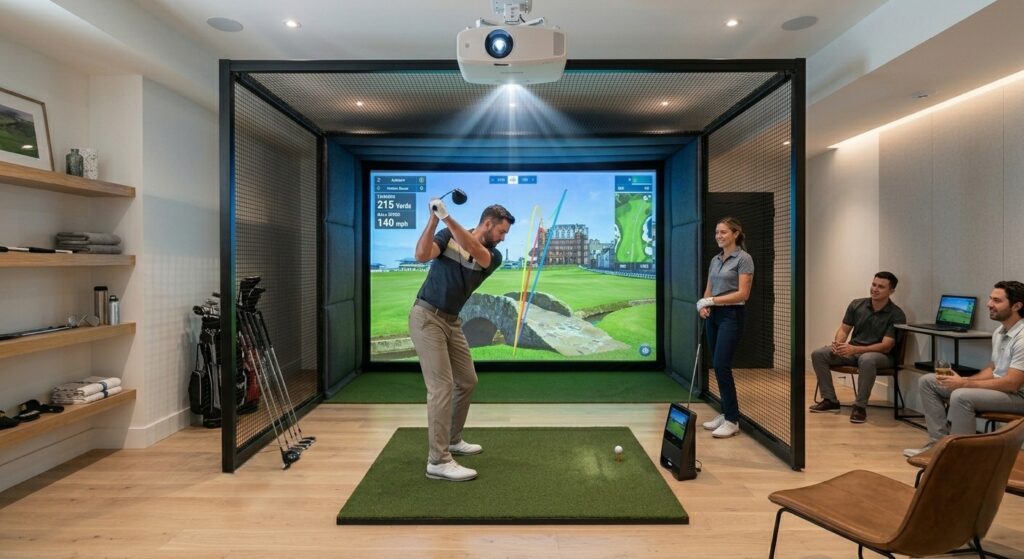
Where budget radar units struggle heavily is indoors, where limited ball-flight space leads to calculated, rather than measured, spin data. If you are building a permanent indoor golf environment, investing in a camera-driven system or a high-end hybrid unit ensures your hooks and slices register accurately on the screen exactly as they would on a real golf course.
Comparison Summary
- Choose SkyTrak+ if you want the best balance of pro-grade accuracy, deep course selection, and reasonable upfront pricing for a permanent indoor space.
- Choose Square Golf if you are building an indoor-only simulator bay on a strict budget and refuse to pay recurring annual subscription fees.
- Choose Foresight Sports GC3 if you are a low-handicap player who demands absolute data perfection and wants to track precise clubface impact metrics.
- Avoid budget radar units if your space is short on depth, as insufficient ball-flight distance will ruin your indoor accuracy.
Final Take
If you have a minimum 9-foot ceiling and the space to swing your longest club freely, investing in a home simulator system will drastically accelerate your game development by allowing you to practice intentionally year-round.
- Who should buy: Golfers looking to get high-repetition practice sessions, play iconic courses during the winter, and analyze real performance metrics without driving to the course.
- Who should skip it: Players with cramped rooms under 9 feet tall or those unwilling to purchase the necessary protective impact screens and enclosures required for safe indoor hitting.
- Best overall pick: SkyTrak+ Launch Monitor. It sits perfectly in the sweet spot of accurate tracking tech, exceptional third-party software integrations, and consumer-tier pricing.
Find more golf sets and monitors in our Sports Equipment Department.
Frequently Asked Questions
Building a home setup comes with plenty of technical questions regarding room sizing, hardware configurations, and software budgets. Below are direct answers to the most common questions players face when shopping for a system.
The SkyTrak+ is the best overall home golf simulator due to its dual-doppler radar and camera system that delivers elite accuracy without commercial-tier pricing.
TrackMan is an industry standard for outdoor tracking and premium commercial installations, but its high cost and immense space requirements make it less practical for standard residential homes compared to Foresight or SkyTrak.
GSPro is widely regarded as the best golf simulator software on the market due to its realistic physics, active community development, and massive library of community-built courses.
A functional entry-level home setup costs between $1,500 and $3,000, while a mid-tier system averages $4,000 to $7,000. Premium, tour-level home installations easily exceed $15,000.
You need an absolute minimum ceiling height of 9 feet, but 10 feet is the recommended standard to comfortably swing a driver without risking damage to your ceiling or clubs.
Yes, garages are ideal locations for home simulators, provided you have enough clearance for your swing and are using a launch monitor that can handle the specific lighting conditions of the space.
Yes, if you use them for intentional practice. They provide immediate data feedback on ball speed, launch angles, and spin rates, which helps players fix swing flaws much faster than blind driving range practice.