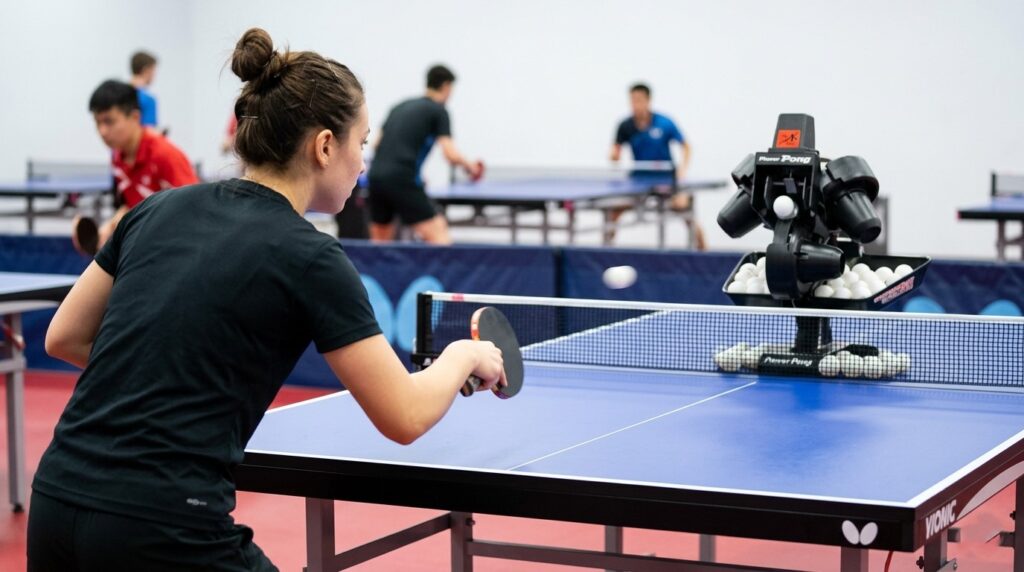
Training solo shouldn’t feel like a chore. If you want to sharpen your footwork or master a heavy topspin loop without a partner, finding the best table tennis robot is the fastest way to see results. We have analyzed the market to cut through the noise, focusing on reliability, spin variety, and ease of use so you can stop researching and start practicing.
Our Top Picks at a Glance
These three models represent the peak of performance and value for the 2026 season.
- The Pro Choice: Power Pong Omega – Unmatched app control and realistic drill programming.
- The Value King: Newgy Robo-Pong 2055 – Industry-standard reliability for intermediate players.
- The Budget Pick: IPONG V300 – A simple, effective ping pong robot machine for home hobbyists.
Comparison Tables
To help you find the right fit immediately, we have organized the top-rated models by skill level and brand reputation. These selections are based on current availability and proven performance on the court.
By Skill Level
Choosing a table tennis training robot depends entirely on how much speed and spin you can handle. Use this table to match a machine to your current playing ceiling.
| Level | Gear Type | Why It Stands Out | Best Use Case | See on Amazon |
| Beginner | IPONG V300 | Dual-wheel oscillation for basic spin. | Casual home practice. | See Price |
| Intermediate | Newgy Robo-Pong 2055 | Digital precision and recycling net. | Club-level footwork drills. | See Price |
| Advanced | Power Pong Omega | Random hole distribution and app sync. | Professional tournament prep. | See Price |
Best Brands Comparison
Not all manufacturers are equal when it comes to long-term durability and motor quality. We have narrowed the field down to the three most trustworthy names in the industry.
| Brand | Gear Type | Strength | Weakness | Our Pick | See on Amazon |
| Power Pong | Professional Robot | Most realistic ball trajectory. | High price point. | ⭐ The Best | See Price |
| Newgy | Training Robot | Incredible durability/parts support. | Interface feels dated. | The Workhorse | See Price |
| Butterfly | Amicus Series | High-end triple wheel tech. | Complex setup process. | The Specialist | See Price |
Pros and Cons of Each Category
Understanding the trade-offs between a budget automatic table tennis robot and a professional rig is essential before you buy. Here is the honest breakdown of what to expect.
| Category | Pros | Cons |
| Budget/Entry Level | * Affordable * Portable * Easy setup | * Limited spin combos * Frequent jams |
| Mid-Range/Club | * Includes recycling net * Consistent motors | * Bulky to store * Moderate learning curve |
| Professional | * App-controlled drills * Realistic “no-spin” balls | * Significant investment * Requires permanent space |
Key Features Breakdown
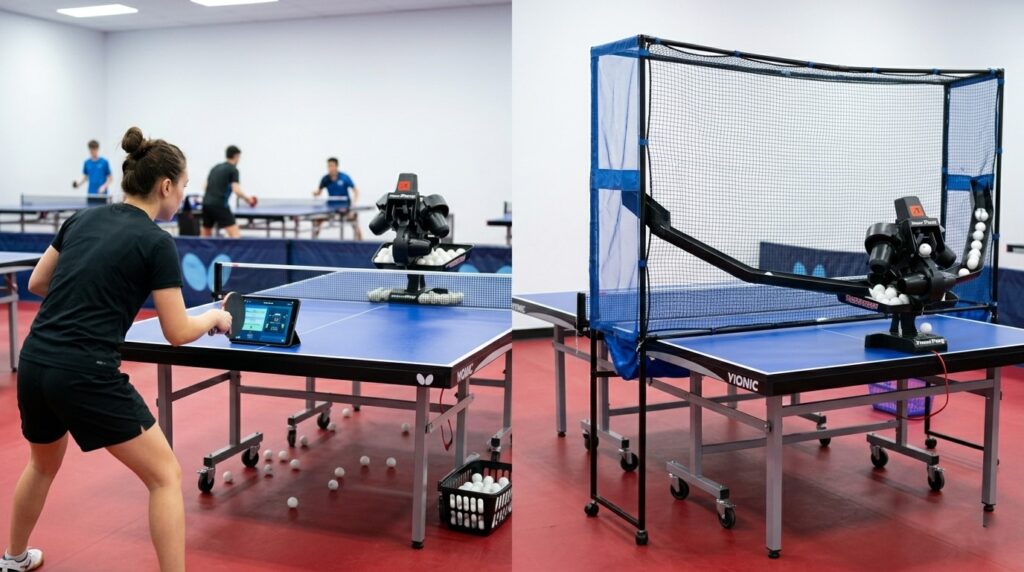
When evaluating a robot for table tennis practice, only a few technical specs actually impact your growth as a player. Focus on these five pillars to ensure your investment pays off.
- Spin Variety: Look for dual-wheel or triple-wheel systems; these allow the machine to produce heavy topspin followed immediately by backspin without manual adjustment.
- Ball Recycling: Higher-end models come with a collection net that feeds balls back into the machine, allowing for infinite practice sessions.
- Programming Depth: The best ping pong robot should allow you to program “random” sequences to simulate a real human opponent.
- Build Quality: Metal frames and high-friction rubber wheels last significantly longer than all-plastic alternatives.
- Ease of Assembly: Some robots take 30 seconds to set up, while others require a dedicated table and 20 minutes of calibration.
Real Performance
Based on our thorough research and users’ feedback, the performance gap between a table tennis robot machine and a human partner is shrinking. High-end units now mimic the arc and “dip” of professional loops with startling accuracy. Compared with similar products, the cheaper models struggle with ball jamming if you use low-quality or dusty balls, so we recommend using 3-star 40+ balls for all machines.
Comparison Summary
- Choose Power Pong if you are a serious competitive player who needs a coach-level experience at home.
- Choose Newgy if you want a reliable, “set it and forget it” machine that will last for a decade of club use.
- Choose IPONG if you are a casual player looking to get your heart rate up without breaking the bank.
- Avoid any brand without a clear warranty or available replacement wheels, as these parts eventually wear down.
Final Take
The best table tennis robot is the one you will actually use. If you are a beginner or a family looking for fun, skip the $2,000 professional rigs and go with a portable unit. However, if you are training for tournaments, the Power Pong Omega is our overall pick for its ability to replicate match-play pressure.
Find more Racket Sports gear or visit our Training Equipment Section.
Frequently Asked Questions
Choosing the right tech for your game can be confusing. We have answered the most common questions to help clear up any lingering doubts.
The Power Pong Omega is currently the best overall for its advanced app features and ball realism.
Yes, if you lack a consistent practice partner. A robot can provide 10x the repetitions of a standard practice session.
Prioritize ball recycling (a net system) and the ability to adjust spin via a remote or app.
Beginners need consistency and slow speeds; advanced players need varied spin and random ball placement.
The IPONG V300 offers the best “bang for your buck” for under $200.